Average Processor
The Average processor groups as described by Group by, then calculates averages and outputs one average for each group.
| Parameter | Description |
|---|---|
| Input Types | Table (number), Table (number, accumulate=True) |
| Output Types | Table(number) |
| Group by (group_by) |
Grouping processors accept a list of property names to group input items into output items. They produce one output group for an empty list. Most processors generate output from input, often creating one output per input (e.g., DSS input results in DSS output of the same size). Some processors reduce output size by grouping input, performing calculations on each group, and producing one value per group. The output size depends on the grouping scheme, controlled by the Group by configuration parameter. In the case of an empty list, the input is considered to be a single group; thus, the output is of size 1 and either N, DS, or TS. If a list of property names is specified, for example ["system_id", "iface_role"], or a single property is specified, for example ["system_id"], we divide the input into groups such that for each group, every item in the group has the same values for the given list of property names. See the standard deviation processor example for how this works. The output type of a processor depends on a value of the group_by parameter; for an empty list, a processor produces a single value result, such as N, DS, or T, and for grouping by one or more properties it returns a set result, such as NS, DSS, or TS. |
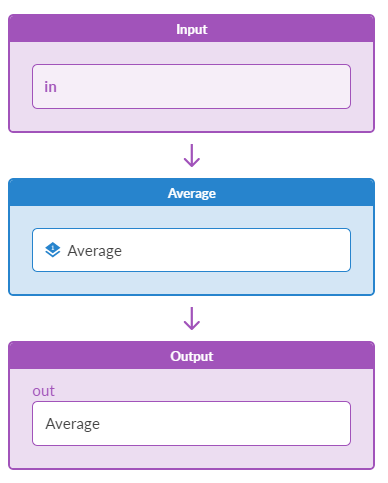
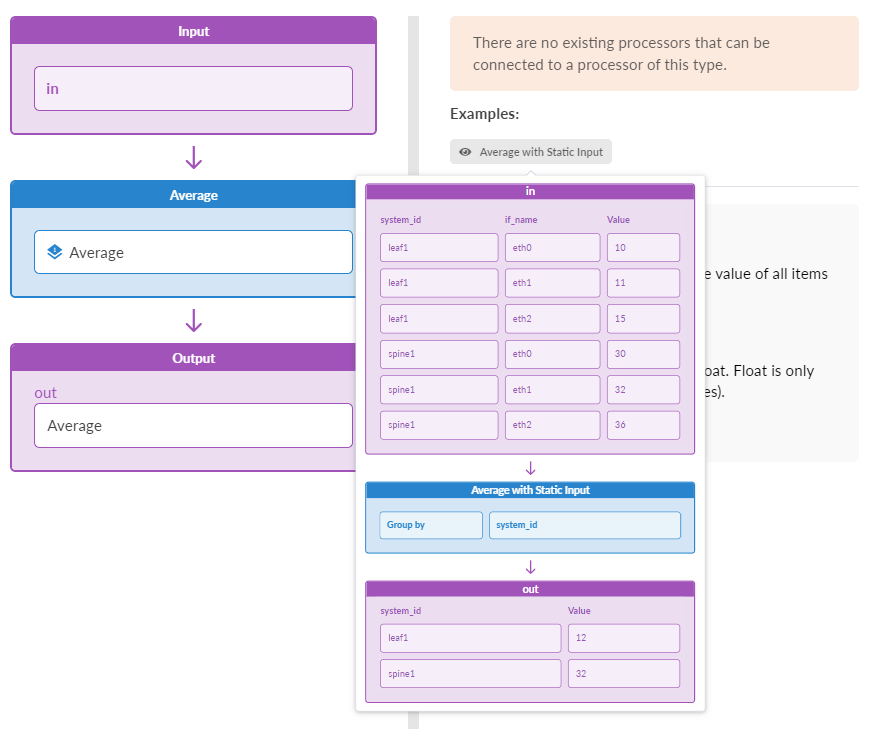
Example: Average
See standard deviation example. It's the same except we calculate average instead of standard deviation.