Example: Configuring Dynamically Assigned Tunnels
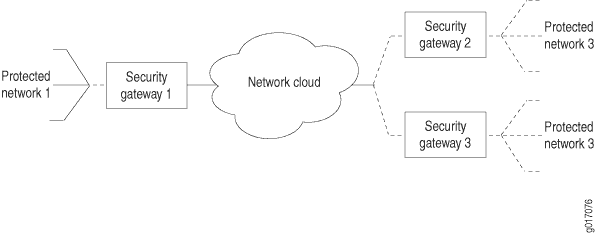
The following examples are based on this network configuration (see Figure 1):
- A local network N-1 behind security gateway SG-1, a Juniper Networks router terminating static as well as dynamic peer endpoints. The tunnel termination address on SG-1 is 10.1.1.1 and the local network address is 172.16.1.0/24.
- Two remote peer routers that obtain addresses from an ISP pool and run RFC-compliant IKE. Remote network N-2 has address 172.16.2.0/24 and resides behind security gateway SG-2 with tunnel termination address 10.2.2.2. Remote network N-3 has address 172.16.3.0/24 and resides behind security gateway SG-3 with tunnel termination address 10.3.3.3.
Figure 1: IPsec Dynamic Endpoint Tunneling Topology
The examples in this section show the following configurations:
- Configuring a Next-Hop Style Service Set with Link-Type Tunnels
- Configuring a Next-Hop Style Service-Set with Policy-Based Tunnels
 | Note: All the configurations are given for the Juniper Networks router terminating dynamic endpoint connections. |
Configuring a Next-Hop Style Service Set with Link-Type Tunnels
| Note: Including the ike-access-profile statement enables the software to incorporate implicit proposals for dynamic endpoint authentication. You do not need to configure IKE or IPsec proposals explicitly. |
The following results are obtained:
- Reverse routes inserted after successful negotiation:
None
- Routes learned by routing protocol:
172.16.2.0/24
172.16.3.0/24
- Dynamic implicit rules created after successful negotiation: rule: junos-dynamic-rule-0term: term-0local-gateway-address : 10.1.1.1 #Tunnel termination address on SG-1remote-gateway-address: 10.2.2.2 #Tunnel termination address on SG-2source-address : 0.0.0.0/0destination-address : 0.0.0.0/0ipsec-inside-interface: sp-0/0/0.3term: term-1local-gateway-address : 10.1.1.1 #Tunnel termination address on SG-1remote-gateway-address: 10.3.3.3 #Tunnel termination address on SG-3source-address : 0.0.0.0/0destination-address : 0.0.0.0/0ipsec-inside-interface: sp-0/0/0.4match-direction: input
Configuring a Next-Hop Style Service-Set with Policy-Based Tunnels
| Note: Including the ike-access-profile statement enables the software to incorporate implicit proposals for dynamic endpoint authentication. You do not need to configure IKE or IPsec proposals explicitly. |
The following results are obtained:
- Reverse routes injected after successful negotiation:demo-vrf.inet.0: .... # Routing instance172.11.0.0/24 *[Static/1].. > via sp-0/0/0.3172.12.0.0/24 *[Static/1].. > via sp-0/0/0.3
- Dynamic implicit rules created after successful negotiation:rule: junos-dynamic-rule-0term: term-0local-gateway-address : 10.1.1.1 #Tunnel termination address on SG-1remote-gateway-address: 10.2.2.2 #Tunnel termination address on SG-2source-address : 172.16.1.0/24destination-address : 172.16.2.0/24ipsec-inside-interface: sp-0/0/0.3term: term-1local-gateway-address : 10.1.1.1 #Tunnel termination address on SG-1remote-gateway-address: 10.3.3.3 #Tunnel termination address on SG-3source-address : 172.16.1.0/24destination-address : 172.16.3.0/24ipsec-inside-interface: sp-0/0/0.3match-direction: input