Pathfinder Applications
Note: † Internal applications are hidden from customers and partners. This is visible to you because you have logged into HPEs internal network.
Navigation
Table of Contents
Guide That Contains This Content
[+] Expand All
[-] Collapse All
PIM Sparse Mode Source Registration
The RPT is a unidirectional tree, permitting traffic to flow down from the RP to the receiver in one direction. For multicast traffic to reach the receiver from the source, another branch of the distribution tree, called the shortest-path tree, needs to be built from the source's DR to the RP.
The shortest-path tree is created in the following way:
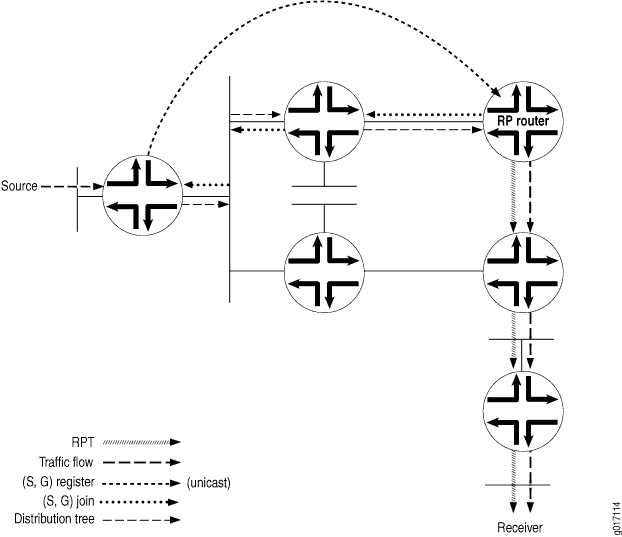
- The source becomes active, sending out multicast packets on the LAN to which it is attached. The source’s DR receives the packets and encapsulates them in a PIM register message, which it sends to the RP router (see Figure 1).
- When the RP router receives the PIM register message from
the source, it sends a PIM join message back to the source.
Figure 1: PIM Register Message and PIM Join Message Exchanged
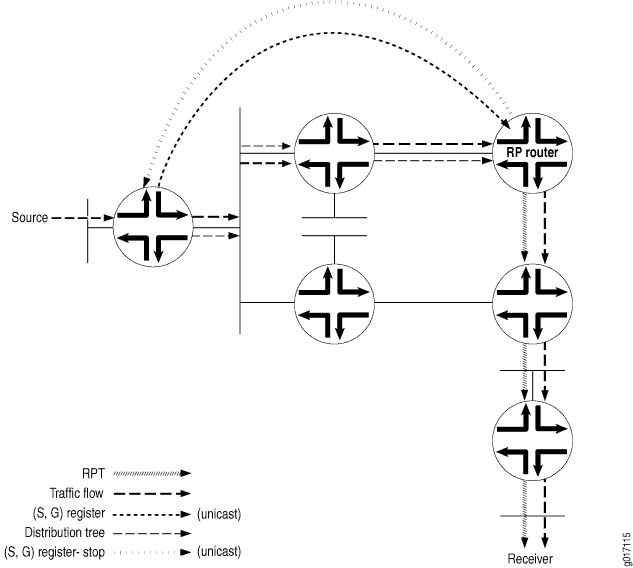
- The source’s DR receives the PIM join message and begins sending traffic down the SPT toward the RP router (see Figure 2).
- Once traffic is received by the RP router, it sends a
register stop message to the source’s DR to stop the register
process.
Figure 2: Traffic Sent from the Source to the RP Router
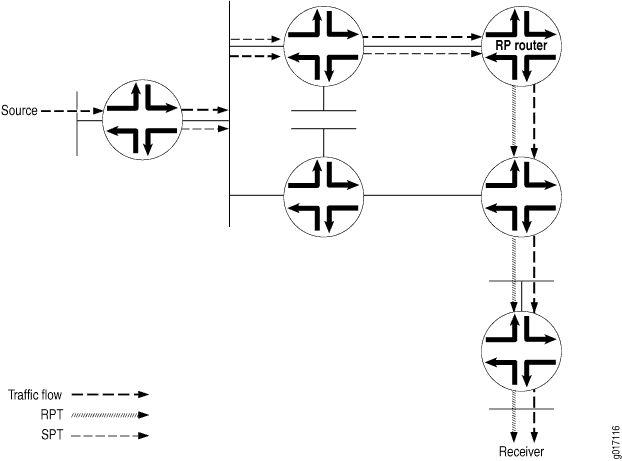
- The RP router sends the multicast traffic down the RPT
toward the receiver (see Figure 3).
Figure 3: Traffic Sent from the RP Router Toward the Receiver