Related Documentation
- J Series
- Multicast Overview
- M Series
- Multicast Overview
- MX Series
- Multicast Overview
- PTX Series
- Multicast Overview
- SRX Series
- Multicast Overview
- T Series
- Multicast Overview
IPv6 Multicast Flow
IPv6 Multicast Flow Overview
The IPv6 multicast flow adds or enhances the following features:
- IPv6 transit multicast which includes the following packet
functions:
- Normal packet handling
- Fragment handling
- Packet reordering
- Protocol-Independent Multicast version 6 (PIMv6) flow handling
- Other multicast routing protocols, such as Multicast Listener Discovery (MLD)
The structure and processing of IPv6 multicast data session are the same as those of IPv4. Each data session has the following:
- One template session
- Several leaf sessions.
The reverse path forwarding (RPF) check behavior for IPv6 is the same as that for IPv4. Incoming multicast data is accepted only if the RPF check succeeds. In an IPv6 multicast flow, incoming Multicast Listener Discovery (MLD) protocol packets are accepted only if MLD or PIM is enabled in the security zone for the incoming interface. Sessions for multicast protocol packets have a default timeout value of 300 seconds. This value cannot be configured. The null register packet is sent to rendezvous point (RP).
In IPv6 multicast flow, a multicast router has the following three roles:
- Designated router
This router receives the multicast packets, encapsulates them with unicast IP headers, and sends them for multicast flow.
- Intermediate router
There are two sessions for the packets, the control session, for the outer unicast packets, and the data session. The security policies are applied to the data session and the control session, is used for forwarding.
- Rendezvous point
The RP receives the unicast PIM register packet, separates the unicast header, and then forwards the inner multicast packet. The packets received by RP are sent to the pd interface for decapsulation and are later handled like normal multicast packets.
On a Services Processing Unit (SPU), the multicast session is created as a template session for matching the incoming packet's tuple. Leaf sessions are connected to the template session. On the Customer Premise Equipment (CPE), only the template session is created. Each CPE session carries the fan-out lists that are used for load-balanced distribution of multicast SPU sessions.
 | Note: IPv6 multicast uses the IPv4 multicast behavior for session distribution. |
The network service access point identifier (nsapi) of the leaf session is set up on the multicast text traffic going into the tunnels, to point to the outgoing tunnel. The zone ID of the tunnel is used for policy lookup for the leaf session in the second stage. Multicast packets are unidirectional. Thus for multicast text session sent into the tunnels, forwarding sessions are not created.
When the multicast route ages out, the corresponding chain of multicast sessions is deleted. When the multicast route changes, then the corresponding chain of multicast sessions is deleted. This forces the next packet hitting the multicast route to take the first path and re-create the chain of sessions; the multicast route counter is not affected.
| Note: The IPv6 multicast packet reorder approach is same as that for IPv4. |
For the encapsulating router, the incoming packet is multicast, and the outgoing packet is unicast. For the intermediate router, the incoming packet is unicast, and the outgoing packet is unicast.
Multicast Listener Discovery (MLD) Overview
The Multicast Listener Discovery (MLD) protocol manages the membership of hosts and routers in multicast groups. IP version 6 (IPv6) multicast routers use MLD to learn, for each of their attached physical networks, which groups have interested listeners. Each router maintains a list of host multicast addresses that have listeners for each subnetwork, as well as a timer for each address. However, the router does not need to know the address of the listeners—just the address of the hosts. The router provides addresses to the multicast routing protocol it uses; this ensures that multicast packets are delivered to all subnetworks where there are interested listeners. In this way, MLD is used as the transport for the Protocol Independent Multicast (PIM) protocol.
MLD is an integral part of IPv6 and must be enabled on all IPv6 routers and hosts that need to receive IP multicast traffic. Junos OS supports MLD versions 1 and 2. Version 2 is supported for the source-specific multicast (SSM) include and exclude modes.
In include mode, the receiver specifies the source or sources from which it is interested in receiving the multicast group traffic. Exclude mode works the opposite of include mode. It allows the receiver to specify the sources or sources from which it is not interested in receiving the multicast group traffic
For each attached network, a multicast router can be either a querier or a nonquerier. A querier router, usually one per subnet, solicits group membership information by transmitting MLD queries. When a host reports to the querier router that it has interested listeners, the querier router forwards the membership information to the rendezvous point (RP) router by means of the receiver's (host's) designated router (DR). This builds the rendezvous-point tree (RPT) connecting the host with interested listeners to the RP router. The RPT is the initial path used by the sender to transmit information to the interested listeners. Non-querier routers do not transmit MLD queries on a subnet but can trasmit them if the querier router goes down.
All MLD-configured routers start up as querier routers on each attached subnet. The non-querier router on the right is the receiver's DR.
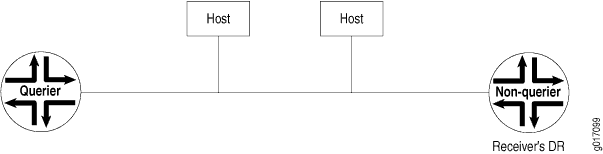
To elect the querier router, the routers exchange query messages containing their IPv6 source addresses. If a router hears a query message whose IPv6 source address is numerically lower than its own selected address, it becomes a non-querier. The router on the left has a source address numerically lower than the one on the right and therefore becomes the querier router.
In the practical application of MLD, several routers on a subnet are nonqueriers. If the elected querier router goes down, query messages are exchanged among the remaining routers. The router with the lowest IPv6 source address then becomes the new querier router. Note that the IPv6 Neighbor Discovery Protocol (NDP) implementation drops incoming Neighbor Announcement (NA) messages that have a broadcast or multicast address in the target link-layer address option. This behavior is recommended by RFC 2461.
Configuration option for IPv6 Neighbor Discovery Protocol (NDP) is available. The configuration option is set protocol neighbor-discovery onlink-subnet-only command. This option will prevent the device from responding to a Neighbor Solicitation (NS) from a prefix which was not included as one of the device interface prefixes.
| Note: The Routing Engine needs to be rebooted after setting this option to remove any possibility of a previous IPv6 entry from remaining in the forwarding-table. |
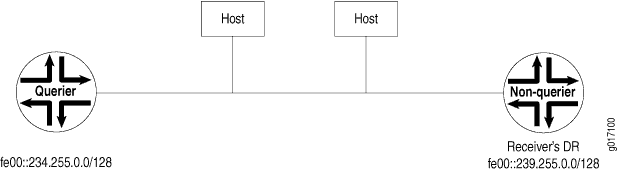
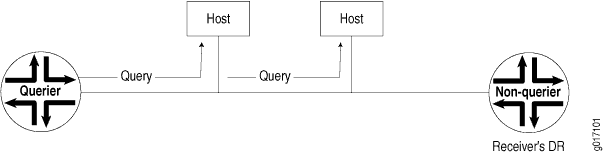
The querier router sends general MLD queries on the link-scope all-nodes multicast address FF02::1 at short intervals to all attached subnets to solicit group membership information. Within the query message is the maximum response delay value, specifying the maximum allowed delay for the host to respond with a report message.
Related Documentation
- J Series
- Multicast Overview
- M Series
- Multicast Overview
- MX Series
- Multicast Overview
- PTX Series
- Multicast Overview
- SRX Series
- Multicast Overview
- T Series
- Multicast Overview