Wireless QoS Priority Overrides
Override the default WMM priority for wireless traffic on a given WLAN.
QoS Priorities
On a wireless network, traffic is not classified by the standard IP layer 3 differentiated service code point (DSCP) tags. Instead, DSCP tags in the L3 packet header are mapped to a Wi-Fi Multimedia (WMM) access categories (AC) according to the 802.11e UP (User Priority) standard. Access points (APs) on the network use the AC values to prioritize packet delivery during times of airtime contention.
You can override the default DSCP to WMM mapping for Juniper® Mist™ access points (APs) in a given WLAN. The feature is called Override QoS. When enabled, APs in the WLAN ignore the standard DSCP mapping and use the selected WMM AC value instead, for all traffic on the WLAN. Override QoS is disabled in the Mist dashboard by default.To enable Override QoS,
- In the Mist menu, select Site | Wireless > WLANs, and
in the page that appears, choose an existing WLAN or click the Create
WLAN button. In the WLAN settings page, under the
QoS Priority section, enable Override
QoS. Figure 1: Reprioritize Wireless Traffic
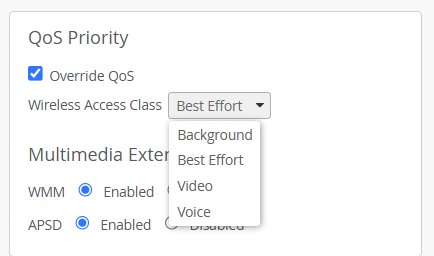
The QoS Priority setting in the WLAN configuration page is not related to the QoS queuing used on the downstream switch. Nor is the QoS used in Mist application policies.
The standard WMM ACs are shown here for reference:
- Voice (AC_VO): Highest priority for things like VoIP calls and Wi-Fi phones to minimize delay and prevent drops.
- Video (AC_VI): High priority for streaming media, video conferencing, and AR/VR.
- Best Effort (AC_BE): Default priority for standard internet browsing and legacy devices.
- Background (AC_BK): Lowest priority for non-urgent tasks like file downloads or print jobs.
On a wireless network, layer 3 DSCP values are translated to layer 2 802.11e UP values, which are then used to determine the AC. Standard mapping convention is to use the three most significant bits of the 6-bit DSCP field to derive the UP (eight possible values), and then map the UP to the WMM queue.