L2 Multitenancy Overview
L2 Multitenancy Introduction
In previous releases, Apstra Data Center Director only supported L3 multitenancy. Tenancy isolation was achieved through VRFs, VLANs, and VXLANs at the routing layer. 6.2 introduces L2 Multitenancy, which enables tenant isolation at L2, enabling Service Providers (SP) and Hosting Providers (HP) to deliver isolated services to multiple tenants on the same fabric.
Each tenant configured for L2 Multitenancy can use the full 4K VLAN range. This feature addresses a common requirement in SP environments because individual tenants often bring their own VLAN numbering configurations that aren’t designed to operate on shared infrastructure.
L2 Multitenancy is built on two main concepts: MAC-VRFs and Switching Zones, along with additional EVPN service types. This document explains these concepts and how they deliver modern fabric use cases.
L2 Multitenancy in Apstra DCD 6.2 is currently supported on QFX5120 and QFX5130 models. For more information about platform-specific behaviors, see Supported Devices.
MAC-VRF Overview
A MAC-VRF is the core construct that makes L2 Multitenancy possible. A MAC-VRF creates L2 isolation between tenants by instantiating multiple independent EVPN instances (EVIs) on the fabric. Each MAC-VRF acts as an EVI and this construct is supported across all Apstra DCD-managed data center platforms. MAC-VRF enables two supported EVPN service types: VLAN-Aware (current default on QFX switches), and VLAN-Bundle. The benefits of MAC-VRF include:
- Enables EVPN service types (VLAN-Aware, VLAN-Bundle,) from a consistent construct.
- Each MAC-VRF is its own EVPN Instance (EVI), which is what gives each tenant its Layer 2 isolation.
- Supported on every Apstra DCD-managed data center platform, with a consistent configuration model across platforms.
Before supporting L2 Multitenancy, Apstra DCD supported only a single virtual-switch instance:
instance-type virtual-switch (VLAN-Aware): Maps one or more routing instances of type Virtual Switch to many VLAN IDs (VIDs) and multiple bridge tables. Each bridge table corresponds to a different VLAN. Only available on QFX10000, MX, and PTX platforms.
With L2 Multitenancy, you can configure multiple MAC-VRF instances, one for each Switching Zone. Note that enabling MAC-VRF for your blueprint does not determine how VLAN IDs are handled, whether VLAN overlap is permitted, or whether Integrated Routing and Bridging (IRBs) are supported for a given tenant. Those behaviors depend on the EVPN service type assigned to each Switching Zone, which is discussed below.
For more information about MAC-VRF, see MAC-VRF Routing Instance Type Overview | Junos OS | Juniper Networks.
Switching Zones
A Switching Zone is the Apstra DCD object that renders a MAC-VRF on your fabric. Each Switching Zone represents one isolated tenant and instantiates its own EVI, with its own EVPN service type, VLAN scope, and forwarding domain. Switching Zonessupport both VLAN-Aware and VLAN-Bundle EVPN service types with isolated forwarding per tenant. Switching Zones are isolated from every other Switching Zone in the blueprint. You can configure multiple Switching Zones per blueprint.
User-defined Switching Zones cannot be extended through Integrated DCI. Only Virtual Networks that belong to the default Switching Zone can be extended through Integrated DCI.
Supported EVPN Service Types
Apstra DCD 6.2 supported two EVPN service types:
| Service Type | VLAN: EVI Mapping |
|---|---|
| VLAN-Aware | N : 1 |
| VLAN-Bundle | Range : 1 |
VLAN Aware
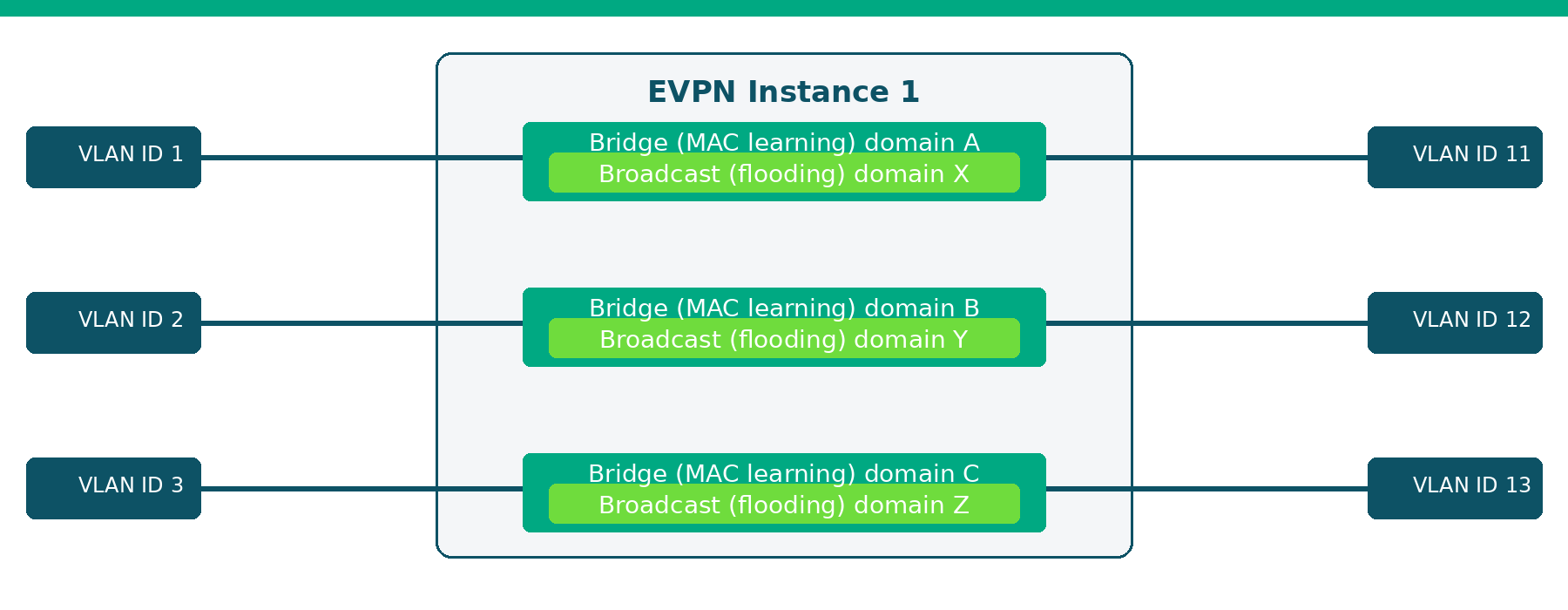
VLAN-Aware maps multiple VLANs (VNIs) into a single EVPN instance. A single route target can be shared across multiple VNIs within the instance, reducing the number of EVPN auto-discovery routes required.
- Supports VLAN-ID overlap within a node, using SP-Style interfaces, or EP (enterprise)-Style interfaces with ingress VLAN rewrites.
- Supports IRB and L3 gateway functionality.
- Type-5 VRF virtualization per edge leaf is available as a complementary design option (see Interconnecting Tenants at Layer 3 in MAC-VRF and Switching Zones).
VLAN-Bundle
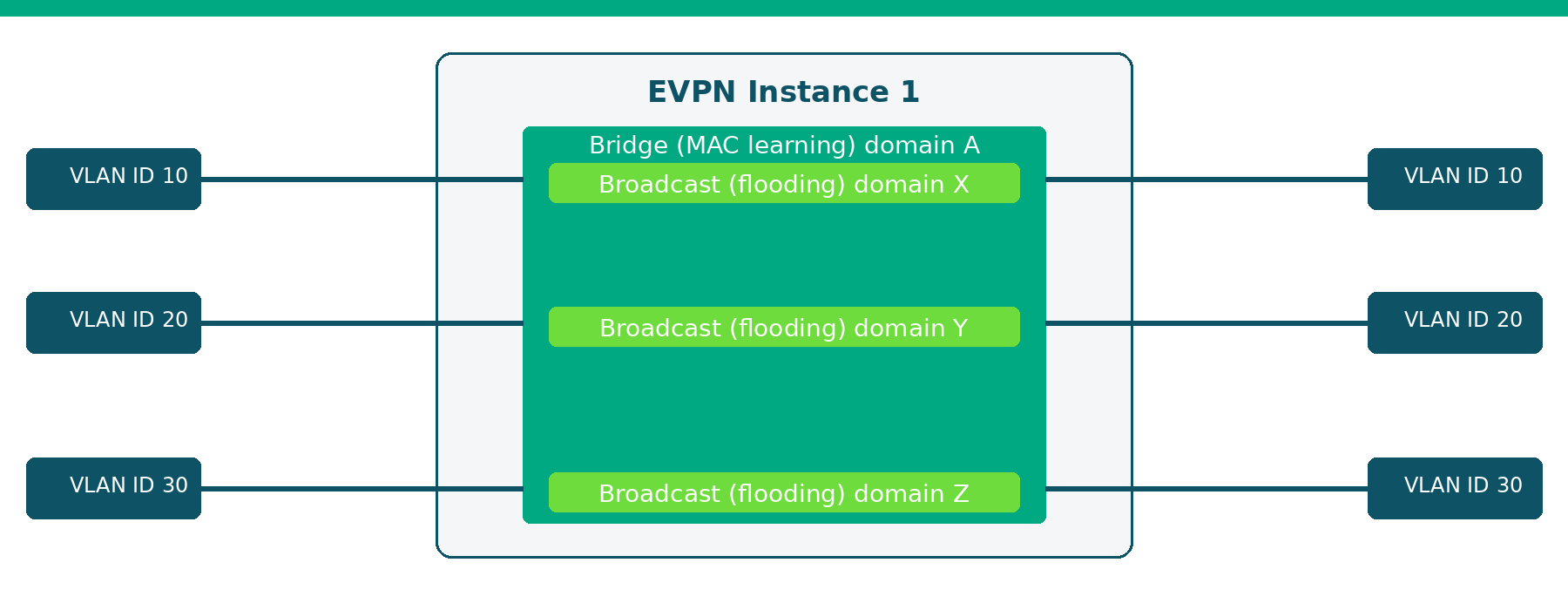
VLAN-Bundle represents an entire range of VLAN IDs under a single MAC-VRF, using a single VNI. VLAN-Bundle is the service type required by the Single-Tagged, Dual-Tagged, and Asymmetric Tagging use cases explained in this guide.
- VLAN IDs must match between the ingress and egress leaf. VLAN-Bundle does not perform any VLAN-ID translation on its own.
- The MAC address table is shared across every VLAN in the bundle. If two VLANs within the same bundle have overlapping MAC addresses, this results in a MAC address conflict.
- No ARP or ND suppression or proxy is performed, and no VLAN-ID processing occurs in the fabric. Every VLAN ID presented by the tenant is carried as-is.
- IRB and Layer 3 gateway functionality are not supported for a VLAN-Bundle Switching Zone. Any inter-VLAN routing required by the tenant must be handled outside the EVPN fabric.
- The primary use case for VLAN-Bundle is port-based Q-in-Q, where a large range of customer VLANs is carried transparently under one VNI and one outer S-VLAN.
Because IRB is not supported under VLAN-Bundle, any tenant using VLAN-Bundle must handle all L3 routing outside the EVPN-VXLAN environment. You can't tie a VLAN-Bundle Switching Zone to a VLAN-Aware Switching Zone.
Flexible Ethernet Services
Flexible Ethernet Services encapsulation allows for a combination of EVPN Service-Types on the same ethernet interface. For example, a single interface can carry a tagged customer on one logical unit and an untagged customer on another logical unit, while both share the same underlying EVPN-VXLAN tunnel on the device.