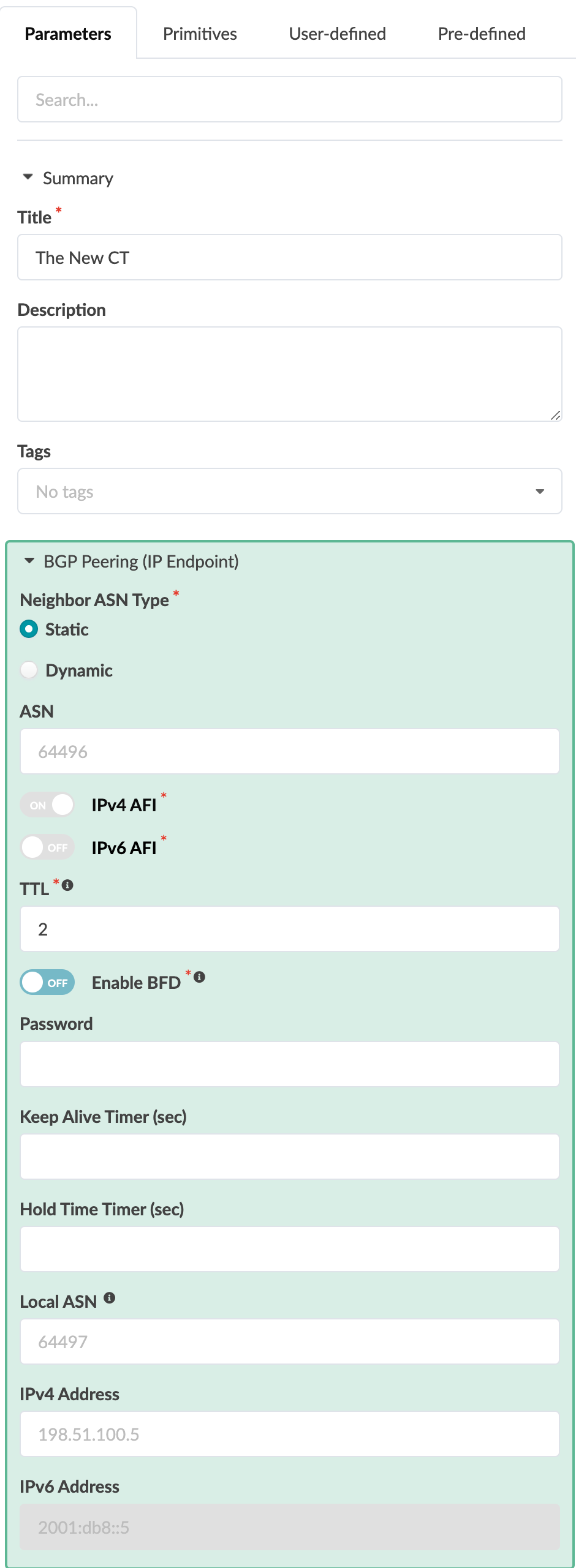
BGP Peering (IP Endpoint) Primitive
The BGP peering (IP endpoint) primitive creates a BGP peering session with a user-specified BGP neighbor addressed peer. You can use this to create a BGP peering session to a Layer 3 server running BGP connected to an Apstra virtual network.
The following parameters must be configured:
- Neighbor ASN type (static, dynamic)
- ASN (if Neighbor ASN type is static)
- IPv4 AFI
- IPv6 AFI
- TTL - BGP Time to Live
- When you set TTL to 0, nothing is configured and the device defaults are used.
- When you set TTL to 1, Cisco NX-OS and FRR-based BGP (SONiC) render disable-connected-check. Otherwise, TTL values render ebgp-multihop on specific BGP neighbors.
- Enable BFD - Enable BFD with interval: 1 sec, multiple: 3 sec
- This enables BFD for the BGP peering. Multihop BFD is only supported for Junos, which is activated by default. For non-Junos devices, set TTL to 1.
- BGP Password
- BGP Keep Alive Timer (seconds)
- BGP Hold Time Timer (seconds)
-
Local ASN - Configured on a per-peer basis. It allows a router to appear to be a member of a second AS by prepending a local-as ASN, in addition to its real ASN, announced to its eBGP peer, resulting in an AS path length of two.
- IPv4 address of peer (if IPv4 AFI is enabled)
- IPv6 address of peer (if Ipv6 AFI is enabled)
You can connect a routing policy primitive to a BGP peering (IP endpoint)